Muscle Preservation at Maintenance Calories: What Happens After the Losing Part Is Over
Oct 29, 2026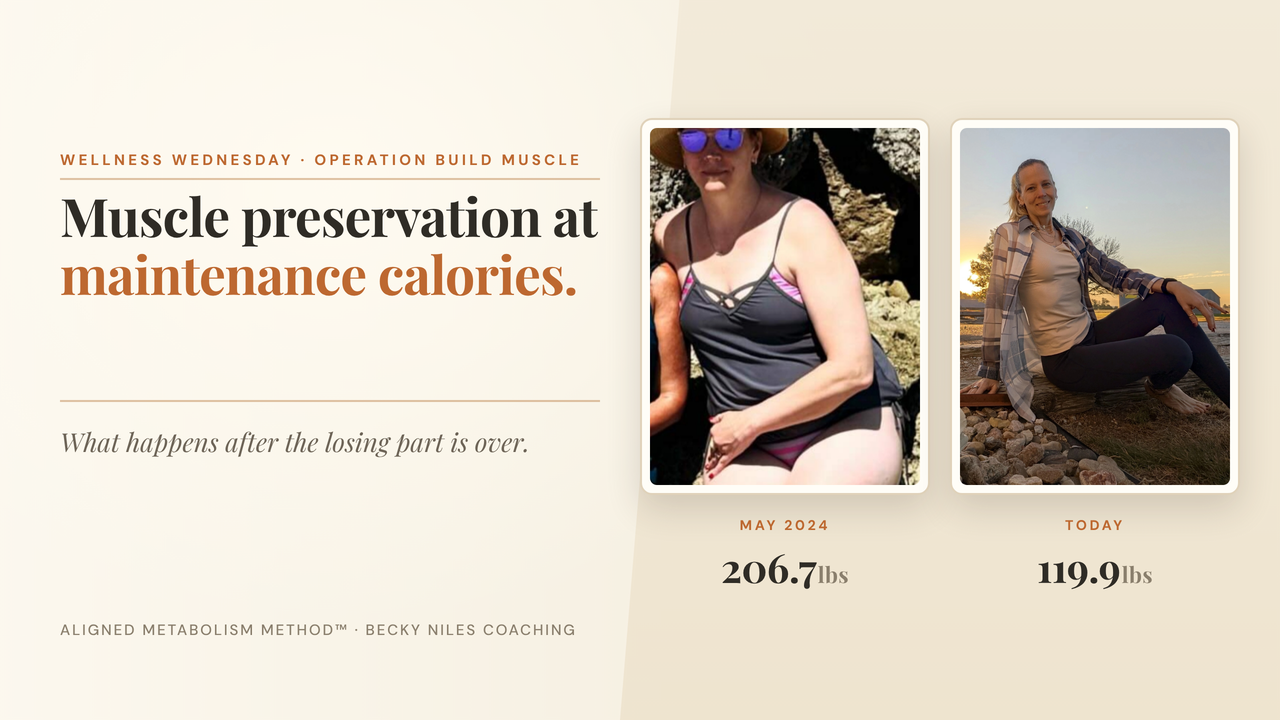
In May of 2024 I weighed 206.7 pounds. This week I weighed 119.9.
That is 86.8 pounds, and it is the least interesting thing I am going to tell you today.
I want to talk about what happened after. Because there is a phase that comes once the losing part is finished, almost nobody describes it to you, and you arrive in it without a map and assume something has gone wrong. I am in that phase right now. It is called keeping, and the technical version of it is muscle preservation at maintenance calories.
This is the part of my story I get the most questions about and the fewest comments on. Nobody shares a post about a week where nothing moved. So let me write the thing I wish somebody had handed me.
The handoff nobody warns you about
For about two years my mind thought I had one job: get smaller. The feedback loop was immediate and generous. I stepped on a scale, the number moved, and that movement felt like proof. On the weeks it did not move I could grit my teeth, because I knew the next week probably would.
Then I hit my range. And the job changed completely, except nobody rang a bell.
Here is what the handoff actually feels like. You keep doing the things because remember we've build our solid foundation. The scale sits still - great body has aligned it's signals. But yet your brain, which has spent two years being paid in falling numbers, reads "still" as "stalled," and "stalled" as "failing." So you think you need to do the thing that has always worked before. You eat less. You add cardio. You tighten up.
And in doing that, you start dismantling the exact tissue you spent two years trying to protect.
I want to be very plain about this, because it is the most expensive mistake I see many women over 40 make. The strategy that got you here is not the strategy that keeps you here. Treating the keeping phase like a smaller version of the losing phase is not discipline. It is a category error.
What maintenance actually is
Maintenance is not a pause. It is not the waiting room between diets. It is not what you do while you work up the nerve to cut again.
Maintenance is a range you live in on purpose, and it is where almost all of the building happens.
Mine is 119 to 125 pounds. Anything inside that is fine. Not "fine for now," not "fine but I should watch it." FINE. That range is a decision I made, and the entire point of making it is that the number inside it stops being a daily verdict on my character.
There is a second reason the range matters, and it is physiological rather than psychological. A body that has been in a deficit for a long stretch makes adjustments. Fothergill and colleagues followed participants from The Biggest Loser for six years and found that the changes to resting energy expenditure persisted long after the weight loss ended (Fothergill E, et al., 2016, Obesity, 24(8):1612-1619). That is an extreme case and I am not claiming it is your case. But it illustrates something worth sitting with: a body reads a long deficit as information, and it responds to that information.
Letting your weight sit still, for longer than feels comfortable, is how you stop handing your body that particular piece of information. It is not laziness. It is a specific intervention with a specific purpose.
Why the scale goes quiet, and why that is not nothing
Here is the hard part of the keeping phase, stated honestly.
The losing phase hands you feedback every single morning. The keeping phase hands you almost nothing. There is no number dropping. There is nothing to screenshot. You have to judge the week on something slower and less satisfying.
And if the scale is the only instrument you own, the keeping phase will genuinely look like a dead stop. Not because nothing is happening, but because the one number you are watching is the one number that is supposed to stay still.
Two people can both weigh 120 pounds. One of them is carrying 90 pounds of lean mass and the other is carrying 78. Same scale reading. Completely different bodies, completely different strength, completely different decades ahead of them. The scale cannot tell those two people apart. It was never built to.
This is why I use the Hume to track more than just weight
I weigh in on a Hume Pod several times a week, and the weight is close to the least useful thing it gives me.
What I actually watch:
Body fat percentage. What share of me is fat tissue. Mine is 22.3 percent, sitting in the low band. This moves when the scale does not.
Lean mass in pounds. The actual poundage of everything that is not fat. Mine read 90.4 pounds on the October 26 scan.
Lean mass rate. Lean mass as a share of total body weight. Mine is 75.4 percent, the highest reading I have recorded since I started tracking. There is a very important catch to this number and I am going to spend a whole section on it below, because it is the one that fools people.
Subcutaneous and visceral fat. Where the fat is sitting, not just how much of it there is. Subcutaneous 23.2 pounds, visceral index 6, both in the low bands.
Body water. 56.6 percent, standard. Hydration status moves lean mass readings around, which is a good reason to look at the trend across weeks rather than reacting to any single scan.
None of that is visible on a bathroom scale. All of it is the actual subject of this phase.
I am not telling you to buy a particular device. I am telling you that if you are entering a keeping phase with weight as your only metric, you have brought one instrument to a job that needs several, and the one you brought is the one least likely to move. If you do choose to purchase the Hume here's my link https://www.humehealth.com/REBECCA62232 save you some $$
The trap inside lean mass percentage
Now the part I promised, and the reason I will keep repeating it in these check-ins.
Lean mass percentage can rise for two completely different reasons.
The first reason is the one you want: you added lean tissue while your weight stayed put. The share went up because the numerator went up.
The second reason is the one that gets celebrated by mistake: your weight fell faster than your lean tissue did. The share went up because the denominator went down. You can lose actual pounds of muscle and watch your lean mass percentage climb at the same time. The graph looks like a win. The tissue says otherwise.
This is why, before I ever write the words "I held my muscle" or "I built muscle," I check lean mass in pounds against my last published figure. Not the percentage. The pounds.
If you take one thing from this post, take that. A rising lean mass percentage is not by itself evidence that you preserved muscle. It is a ratio, and ratios move for two reasons. Check the poundage.
The instruction set
So what does MY keeping phase actually ask me to do? It is short, which is part of why it feels unsatisfying.
Enough protein. At minimum but typically I'm higher than this but the PROT-AGE study group's position paper recommends 1.0 to 1.2 grams of protein per kilogram of body weight per day for healthy older adults, above the general adult reference intake, specifically to support the maintenance of muscle (Bauer J, et al., 2013, Journal of the American Medical Directors Association, 14(8):542-559). Spread it across the day rather than loading it all into dinner.
Lift something heavy, a few times a week. Resistance training is the signal that tells your body the tissue is worth keeping I do 15-20min session 2-3 times per week, short but effective. Longland and colleagues ran a randomized trial in which participants in an energy deficit who combined higher protein intake with intense resistance and interval training gained lean mass while losing fat, compared with a lower protein group doing the same training (Longland TM, et al., 2016, American Journal of Clinical Nutrition, 103(3):738-746). Protein and training together, not either one alone.
Let your weight sit still. This is the one that requires the most nerve, because it looks from the outside like doing nothing. It is not doing nothing. It is the condition under which the first two things can work. Which is also why I created a range for myself not a hard set number.
Daily movement. Ten minutes is the floor, every day, separate from training. Walk after you eat if that is what fits. Maybe it's Squats at the counter. Possibly a few trips up & down the stairs
That is the entire protocol ok maybe not the entire protocol but the just of it with the foundational basics of the AMM program. But it is still No pills, no pokes, no potions I not adding a vitamin shop to my kitchen to maintain it. It is not complicated and it does not photograph well which is why I call my workouts the imperfect workouts. But this is precisely why nobody sells it to you it doesn't have a fancy slogan, it doesn't offer quick results & it sure can't be wrapped up in a bottle - YOU have to be willing to put in the work .
Why any of this matters past the mirror
Muscle is not decoration. Wolfe made the case nearly twenty years ago that skeletal muscle is routinely underappreciated as a metabolic organ, serving as the body's largest reservoir of amino acids and the primary site of glucose disposal (Wolfe RR, 2006, American Journal of Clinical Nutrition, 84(3):475-482).
Translated out of journal language: the tissue you are protecting in your forties is the tissue that determines how you handle a meal, how you recover from a hard week, how you get up off the floor at seventy five, and whether a stumble in your eighties is a stumble or an event.
That is the actual return on the keeping phase. It does not show up in a before and after photo. It shows up in a decade you have not lived yet.
Where I am, honestly
My October 26 scan: body fat 22.3 percent, low band. Lean mass 90.4 pounds, high band. Lean mass rate 75.4 percent, high band and my highest recorded reading. Subcutaneous fat 23.2 pounds, very low. Visceral fat index 6, low. Body water 56.6 percent, standard. Metabolic age 38 against a chronological 45.
What I am not going to tell you is that this was a perfect month, because these numbers are a snapshot and one snapshot is not a trend. The honest version is that I am inside my range, my fat markers are sitting low across the board, and my next job is specific and unglamorous: my composition is lower body dominant, so upper body resistance work is the assignment in front of me.
That is what Operation Build Muscle is. Me doing this work out loud, with the real numbers, every week, including the weeks where the interesting thing is that nothing moved.
If you are standing in this handoff
If you are anywhere near your own maintenance range and still running the losing phase playbook, you are not lacking discipline. You are running the right strategy for the wrong phase, and nobody told you the phase had changed.
Here is what I would do this week, whether or not we ever work together.
Name your range, and make it a real range rather than a single number. Decide in advance that anything inside it is fine. Then move your attention onto the things that are actually moving: your protein, your training, and what your body composition is doing underneath a weight that is holding steady.
If you want help building that, the Aligned Metabolism Method is how I teach it, and 1:1 coaching is where we build it around your life. It comes two ways: a 12-session package, or a monthly commitment if you want weekly sessions. Either way the coaching app keeps you accountable between our calls, so the work does not live or die on session day.
If you are not sure which shape fits you, that is exactly what the discovery call is for. You can book
Ways to work with me
Every option below is a different depth of support, and all of my coaching is a root-cause & eligible ways to use your HSA/FSA funds before they reset at year-end, so you can start the new year already on the right foot.
1. Monthly 1:1 Coaching Weekly 1:1 Zoom sessions, direct message access, and real accountability, customized to your nutrition, movement, circadian rhythm, and stress. No long-term commitment, cancel anytime. 👉 Start monthly coaching
2. The Aligned Metabolism MethodTM (12 & 6 Coaching Package) My signature 1:1 package: 12 private coaching sessions and 6 months to use them, your way. Build a strong foundation, then shift into check-ins to refine and sustain. 👉 Start the AMM package
3. The Aligned Season Program (Coached) A full year of coaching that aligns your light, food, movement, and rest with the seasons. 36 live 1:1 sessions, seasonal modules, your AMM Hub, and ongoing accountability with me. 👉 Explore the Aligned Season Program
Not sure which one fits? Message me "COACH" and tell me where you're at. I'll help you find the right starting point and walk you through using your HSA/FSA funds.
Individual results vary. This content is educational and not a substitute for medical care.
If I've had the pleasure of working with you, comment below. 🤍 Becky
New check-in every Wednesday. The blog version lands on Thursdays.
This article is for educational purposes and describes structure and function. It is not medical advice and does not diagnose or treat any condition.
Join the BNC Community
Ready to take your healing journey to the next level? Join the Beyond Nutrition Community (BNC) for personalized support, expert guidance, and a network of like-minded individuals dedicated to holistic wellness. Visit Beyond Nutrition Community to get started today!
Stay connected with news and updates!
Join our mailing list to receive the latest news and updates from our team.
Don't worry, your information will not be shared.
We hate SPAM. We will never sell your information, for any reason.
