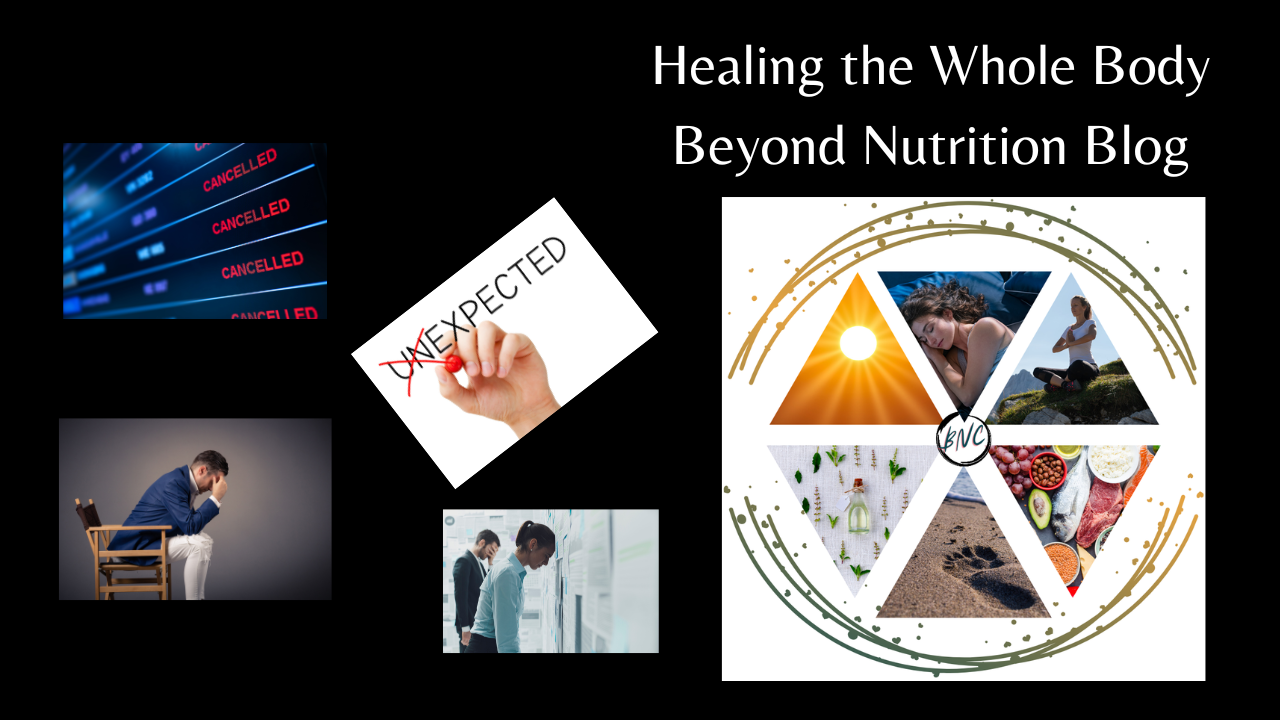
Life has a way of shifting without warning. One moment you’re moving through your day feeling steady and, in your rhythm, and the next, something unexpected hits. A phone call, a text, a sudden responsibility, a wave of emotion you didn’t see coming curveballs arrive fast, and they rarely ask for permission. When they do, it can feel like the version of you who was grounded and focused suddenly slips out of reach. Most people assume they derail because they lack discipline or willpower, but the truth is far more compassionate: you’re not falling off track because you’re weak. You’re falling off track because your nervous system is overwhelmed. And overwhelmed systems don’t need judgment, they need support.
We were reminded of this recently on the Beyond Nutrition Community Podcast. Our guest needed to reschedule at the last minute, and suddenly the episode we had planned wasn’t the episode we could go live with. Instead of scrambling or forcing something that didn’t fit, Becky and I took a breath, grounded ourselves, and pivoted literally. We shifted the entire theme to “Pivoting: When Life Throws Curveballs,” (click here to watch) and what could have felt like a setback became a honest, real, and relatable conversation. It was a living example of everything we teach: curveballs don’t just happen to our listeners they happen to us too. And sometimes the pivot becomes the point.
When something unpredictable happens, your brain immediately scans for danger. Even if the situation isn’t actually dangerous, your body reacts as if it is. Your heart rate rises, your breath shortens, your thoughts scatter or shut down, and your executive function the part of your brain that helps you plan, prioritize, and stay consistent goes offline. This is why you might suddenly abandon routines that were working, reach for old coping mechanisms, feel unmotivated or overstimulated, or slip into all‑or‑nothing thinking. It’s not a character flaw. It’s physiology doing exactly what it was designed to do.
The moment after the curveball is when most derailments begin. Before you react or try to fix anything, your body needs to know it’s safe. A few simple micro‑stabilizers can interrupt the spiral before it starts. Looking around the room and naming a few things you see helps your brain reorient to the present moment. Do box breathing. Here’s how it works in the body: when you slow your breath and make the exhale as long as the inhale, you signal to your vagus nerve that you’re safe enough to shift out of fight‑or‑flight. Your heart rate steadies. Your thoughts slow down. Your muscles soften. It’s a pattern interrupt for stress gentle, accessible, and doable anywhere.
And here’s how to practice it:
Inhale for 4 counts. Hold for 4 counts. Exhale for 4 counts. Hold for 4 counts.
That’s one “box.” You can repeat it for 3–5 rounds, or longer if you feel your body settling. What makes box breathing so powerful is its simplicity you don’t need equipment, privacy, or a long stretch of time. You can use it in the car, in a meeting, before a difficult conversation, or in the exact moment you feel yourself starting to derail.
Even a small movement like shaking out your hands or rolling your shoulders can break the freeze response. And shifting your inner dialogue from “Why is this happening to me?” to “What does this moment need from me?” creates just enough space to respond instead of reacting. From there, choosing one tiny action a sip of water, a step outside, a stretch can help you regain your footing.
When life gets chaotic, you don’t need a perfect plan; you need a compassionate one. One of the most supportive tools is the three‑tier day structure. Tier One includes your non‑negotiables: sleep, hydration, protein, medication, and basic movement. Tier Two includes things that matter but can flex. Tier Three is everything optional. On hard days, Tier One is enough. You’re allowed to shrink your day without shrinking your worth. Another powerful tool is the “good enough” protocol asking yourself what the 60% version of a task looks like and letting that be enough. Perfection is fragile; consistency is resilient. You can also anchor yourself with the 24‑hour outcome question: “What outcome do I want to feel tomorrow morning?” This simple shift moves you from emotional reaction to intentional response. And having a “chaos plan” a simplified version of your routines for tough weeks gives you something to fall back on when your capacity is low. Sometimes the most supportive thing you can do is ask for help with one small task instead of trying to carry everything alone.
Even with the best tools, derailment will still happen and that’s okay. It’s part of the growth cycle. Instead of spiraling into shame, try acknowledging what happened without judgment. “Of course I struggled that was a lot.” Then identify what you actually needed in that moment: rest, support, clarity, boundaries. From there re-enter gently. You don’t need to make up for lost time. You simply need to begin again from where you are. Returning to yourself is always more important than returning to the plan.
Long‑term resilience isn’t about becoming tougher; it’s about becoming more supported. Start by anchoring into identity: “Who am I becoming, and how does that version of me handle chaos?” Then build capacity by strengthening your nervous system through sunlight, protein, strength training, sleep, breathwork, and community. Finally, look at the architecture of your life. Simplify what drains you. Automate what you can. Delegate what doesn’t need your hands. Release what no longer fits.
Curveballs don’t define you your recovery does. You don’t need to be perfect; you need to be present. And you don’t need to hold everything together; you just need to hold onto yourself. If you’re in a curveball season right now, take a breath. You’re not behind. You’re not failing. You’re navigating something hard with a nervous system that’s doing its best to protect you. And you can always begin again.
--Coach Sherri
Join the BNC Community
Ready to take your healing journey to the next level? Join the Beyond Nutrition Community (BNC) for personalized support, expert guidance, and a network of like-minded individuals dedicated to holistic wellness. Visit Beyond Nutrition Community to get started today!
Stay connected with news and updates!
Join our mailing list to receive the latest news and updates from our team.
Don't worry, your information will not be shared.
We hate SPAM. We will never sell your information, for any reason.
